


A correct film structure can still stop a packing line when the core will not fit, the roll is too large, or operators cannot load it safely.
Buyers should specify core inside diameter, core width, maximum finished roll outside diameter, and maximum roll weight from their unwinder limits. They should also confirm web width, winding direction, film length, splice rules, and handling method before approving bulk packaging film.
I will show how to name each roll dimension, collect reliable machine limits, balance roll length against handling, and build a production-ready specification.
What Do Core Size and Maximum Roll Diameter Actually Mean?
Terms such as core size, roll diameter, and roll width sound simple, but an undefined reference point can make a supplier manufacture the wrong format.
Core size should identify the tube's inside diameter, outside diameter when relevant, wall thickness, width, and material. Maximum roll diameter means the largest finished outside diameter the unwinder can accept. Buyers should state both dimensions with units and tolerances instead of using a nominal core name alone.
Name every dimension on a drawing
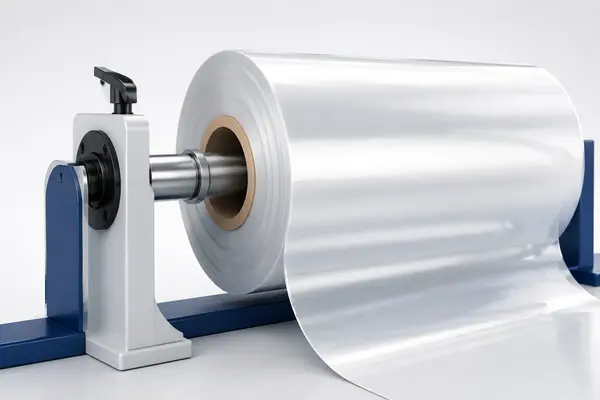
When I review a rollstock inquiry at XINYUAN, I separate the core from the wound film. The core inside diameter, often shortened to core ID, must match the shaft, chuck, mandrel, or other mounting system. The core outside diameter and wall thickness affect the tube body. The core width controls how the tube sits relative to the film edges and machine supports.
The finished roll outside diameter, often shortened to roll OD, is measured across the complete wound roll. It is not the same as the core diameter. A machine may accept the core but still lack space for an oversized finished roll. Guards, brakes, sensors, frames, and nearby machine parts can all reduce available clearance.
| Specification | What it describes | Common sourcing risk |
|---|---|---|
| Core inside diameter | Opening that fits the shaft or chuck | Core cannot mount or grip correctly |
| Core outside diameter | External size of the empty tube | Wound length calculation uses the wrong base |
| Core wall thickness | Distance between core ID and OD | Core construction does not match handling needs |
| Core width | Tube length from edge to edge | Core projects too far or gives poor edge support |
| Finished roll OD | Largest diameter after film is wound | Roll contacts the machine frame or guard |
| Web width | Slit film width across the roll | Film does not track through guides or forming parts |
I recommend using a labeled sketch with measurement arrows. The purchase order should identify the controlling unit, such as millimeters or inches. If both units appear, one must control because conversion and rounding can create conflicting targets. A nominal description by itself is not enough for custom production.
How Should Buyers Determine Their Machine and Handling Limits?
An old purchase record may describe what was supplied before, but it may not capture the true limits of the current unwinder, guard, shaft, or loading method.
Buyers should obtain limits from the machine manual, equipment supplier, co-packer, and line measurement. They need the permitted core ID and width, maximum roll OD and weight, shaft or chuck type, web path, loading clearance, brake arrangement, and approved lifting or manual-handling method.
Inspect the full unwind station
I ask buyers to collect information from the people who actually install and run the roll. A purchasing record can omit a retrofit, replacement shaft, safety guard, or revised loading tool. The operator may know that the theoretical maximum diameter leaves too little room for a practical changeover. The equipment supplier or co-packer can confirm which limits are fixed and which depend on the setup.
The team should check more than open space around the roll. The shaft or chuck needs the correct interface with the core. The roll must sit in the intended lateral position. The web must travel through guides and sensors without rubbing an edge. The brake or tension system must work with the planned roll mass and diameter range. The loading method must also suit the roll weight and access route.
| Source to check | Questions to answer |
|---|---|
| Machine manual | What core, roll OD, roll weight, and web-width limits are stated? |
| Equipment supplier | Do limits change with shafts, chucks, brakes, guards, or options? |
| Co-packer | What exact roll format does the approved line receive? |
| Line operator | What size allows reliable loading, threading, tracking, and changeover? |
| Safety or operations team | How is the roll lifted, moved, stored, and installed? |
I recommend documenting the approved operating limit, not simply the largest roll that can be pushed into the available space. The buyer should also photograph or sketch the mounting interface without relying on the image as the dimensional authority. Written measurements and equipment confirmation should control the order.
The web path also determines the required print orientation. Buyers can review our separate guide on confirming unwind direction for printed packaging film rolls after the physical roll envelope is known.
How Do Roll Diameter, Length, Weight, and Changeovers Interact?
A larger roll can reduce changeovers, but it also carries more film, weighs more, needs more clearance, and may behave differently during acceleration and braking.
Buyers should choose roll OD by balancing required film length, film thickness, core OD, roll density, weight limits, changeover goals, and unwinder control. They should not convert an OD limit directly into an exact length or weight without a supplier calculation and an approved trial roll.
Treat the roll as a connected specification
Film length, thickness, and the diameter of the wound roll are connected. More length generally creates a larger and heavier roll, but the exact relationship also depends on the actual material construction and winding condition. A buyer may want longer rolls to reduce stops and core changes. However, the benefit disappears if the roll exceeds the machine, lifting, storage, or operator limit.
The RFQ should therefore state which value is mandatory and which is a target. For example, the maximum roll OD and maximum roll weight may be hard machine and handling limits. The desired length or impressions per roll may be a planning target that the supplier adjusts within those limits. The buyer should also define whether partial final rolls are acceptable and how roll length will be reported.
| Procurement goal | Potential benefit | Constraint to verify |
|---|---|---|
| More film per roll | Fewer roll changes | Maximum OD, weight, braking, and lifting |
| Smaller rolls | Easier manual movement and shorter trial runs | More changes, more cores, and more roll starts |
| Fixed impressions per roll | Predictable production planning | Repeat length, OD, weight, and allowable variation |
| Fixed roll weight | Easier inventory or handling control | Actual yield depends on film width and construction |
I recommend requesting a written roll calculation from the manufacturer after the film structure, thickness, web width, core, and length target are confirmed. The buyer should then run a production-representative trial. The trial should cover loading, threading, starting, steady running, stopping, registration, tension, roll change, and disposal or return of the empty core. One successful start does not prove that the full diameter range will run consistently.
What Should the RFQ and Approval Record Include?
Even a successful trial can be lost on reorder when the specification lives in emails, photographs, machine notes, and artwork files with different revision dates.
The controlled RFQ should list machine and line, web width, repeat length, core ID and width, maximum roll OD and weight, target roll length, winding direction, print face, sealant orientation, splice rules, edge quality, labeling, packing, tolerances, and the approved trial reference.
I recommend creating a single controlled sheet that purchasing, production, quality, the co-packer, and the film manufacturer all use. The sheet should name the packaging machine and line because one factory may operate several unwinders with different limits. It should place core and roll dimensions beside a clear drawing, then connect those physical requirements to the printed web.
The print section should define the web width, repeat length, registration-mark position, copy direction, print face, and sealant side. The roll section should define the winding orientation, core, OD, weight, length target, roll edge expectations, and splice policy. The logistics section should define roll identification, protective packing, pallet orientation, and any handling information the buyer requires.
| RFQ group | Required buyer information |
|---|---|
| Equipment | Machine model, line, unwinder type, shaft or chuck, and loading method |
| Roll geometry | Core ID, core width, web width, maximum OD, maximum weight, and tolerances |
| Web setup | Repeat, unwind direction, print face, sealant side, and registration mark |
| Roll makeup | Target length or impressions, permitted variation, and partial-roll rules |
| Quality rules | Splice type and count, edge condition, identification, and inspection method |
| Approval | Drawing revision, artwork revision, trial-roll ID, result, and approver |
XINYUAN manufactures packaging bags and film rolls through an integrated production organization, as described on our company page. Our equipment and experienced production employees support large orders and long-term supply as an operating focus, not an unconditional guarantee. Clear, controlled specifications help us align raw materials, printing, slitting, winding, inspection, and packing with the buyer's line.
We provide free in-stock samples and free artwork or typesetting service for early review. A separately produced custom sample or trial may require a sample fee. For a later bulk order, we can return or deduct that fee from the bulk-order price, subject to the confirmed quotation. If a printed pattern requires printing plates, a plate fee may apply and is paid to the plate-making factory. Reusing the same confirmed pattern in a later order normally does not require a new plate fee.
Conclusion
Specify the core, roll envelope, weight, web setup, handling limits, and approval record together, then confirm the complete format with a representative machine trial.