


When film layers slide sideways, a roll can arrive within its width specification and still rub against the unwind frame. I specify roll face alignment separately.
I specify a maximum axial layer offset on each roll face, with an agreed reference plane and measurement method. I check both faces before shipment and at receipt, then confirm the limit on the buyer’s unwind using representative full rolls.
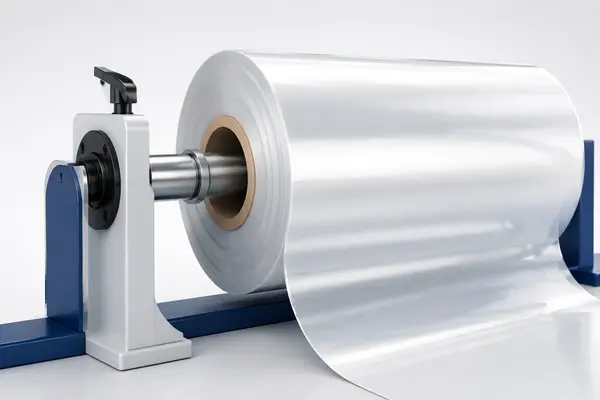
At XINYUAN, we manufacture flexible packaging film rolls. I’ll show how I separate a winding defect from a width problem, put a measurable limit on the purchase order, and use a line trial to decide what the limit should be.
How do I distinguish telescoping from the wrong film width?
A stepped roll face can look like a width problem. If I change the slit width before checking the wound layers, I may solve the wrong problem.
I call it telescoping when successive layers or groups of layers shift sideways along the core axis. I check the width of the flat web separately from the shape of the wound roll face and the position of the core.
I look at the layers, core, and flat web separately
I start with a side view of the roll while it is still in its received condition. A group of layers that projects progressively beyond adjacent layers points to an axial shift. A single turned or dented edge looks different, but I still photograph it and ask how it will affect the unwind. I mark the roll label and the affected side in the same photo set so the converter can match the report to its winding records.
I then compare three things. The flat web width tells me whether the film itself was slit to size. The roll face tells me how well those layers line up on the core. The core position tells me whether the whole wound pack is shifted relative to the mounting surface. A flat roll face can pass an alignment check while a protruding core fails a separate mounting check.
| What I see | What I check next |
|---|---|
| A stair step across groups of layers | Axial layer offset and the radial band affected |
| Flat faces but unequal core projection | Core location relative to the film pack |
| Film consistently too wide after unwinding | Slit width on flat, undamaged web |
| One crushed edge near a carton impact | Local damage and whether the affected film feeds cleanly |
I avoid judging by the loose tail alone. I record a loose tail or torn wrap separately because it can obscure where the wound layers actually sit. If I cannot tell what shifted from a photograph, I ask for the agreed measurements before making a disposition decision.
How do I write a measurable roll face tolerance?
A purchase order that calls for neat edges leaves inspectors to guess what counts as neat. I give both teams a drawing and a measurement rule.
I put the maximum permitted offset, units, reference plane, measurement positions, and inspection stage on the roll drawing. I specify core projection and total mounted clearance separately, because those dimensions answer different questions.
I make the reference plane visible on the drawing
I ask the buyer and converter to agree on a cross section showing the core, the intended film face, and the direction of measurement. A practical drawing can use a fixture plane located from a specified core end. If a buyer uses a different datum, I show exactly where that datum sits and how the inspector establishes it. I never leave “from the edge” on its own. That phrase can mean the first wrap, the most protruding wrap, or the core end.
I state whether the requirement controls outward projection, inward setback, or both. If a recessed band can cause tracking problems, an outward limit alone will miss it. I specify the number and locations of readings around each face, and I ask inspectors to record the worst value and its location. If one side faces a tighter machine clearance, I label that side on the unwind drawing so receiving staff and the converter measure the same face.
I include a separate check of the overall axial envelope, including the core, where machine clearance is the concern. I also define how the inspector handles the wrap and loose tail and whether a reading applies before shipment, after receipt, or at both points. The agreed method should work without pressing displaced layers back into position. A photo with a visible scale helps explain a rejection; I use the recorded measurement against the drawing to decide whether it passes.
How do I set the limit and verify it before a bulk order?
A roll that fits at loading can still feed unevenly as layers come off. I use machine clearance and a trial to set the purchasing limit.
I start with the unwinder’s available clearance and the buyer’s proven rolls. I trial representative full rolls, record tracking and contact through the unwind, and use those results to agree on release limits and receiving checks.
I separate machine fit from run performance
I ask the buyer for the unwind drawing, core specification, roll width, maximum diameter, and normal running speed. I also ask for a photograph of a proven roll mounted on the shaft. It can show which face sits beside a collar, guide, or frame member. I use these details to identify the narrowest clearance, but I leave room for mounting variation and confirm the final limit with the people who run the machine. A clearance measurement alone does not tell me whether the web will track.
For the trial, I recommend a full roll made with the intended film structure and roll build. A short sample may help confirm print orientation or width, but it does not show how the entire roll feeds. I record the as-received face readings and inspect tracking at startup, at normal speed, and as the roll approaches the core. I ask the operator to note guide corrections, edge rub, wrinkles, and stops with the roll ID and the approximate stage of unwind. If the film runs poorly, I compare it with a known good roll before changing multiple machine settings at once.
For the first bulk shipment, I agree on who checks the rolls, how many are checked, what triggers a hold, and what records go with a claim. If a roll arrives with shifted layers, I ask receiving staff to keep the packaging and photograph it before rewinding or trimming anything. For a quote, I ask buyers to send their unwind drawing, roll dimensions, and a photo of any recurring defect so we can discuss a measurable acceptance limit.
Conclusion
I specify layer offset separately from film width and core position, then confirm the limit with repeatable measurements and a full roll trial before bulk approval.